




Podcast Episode #16: Material Matters, Cut and Fill
May 5, 2026
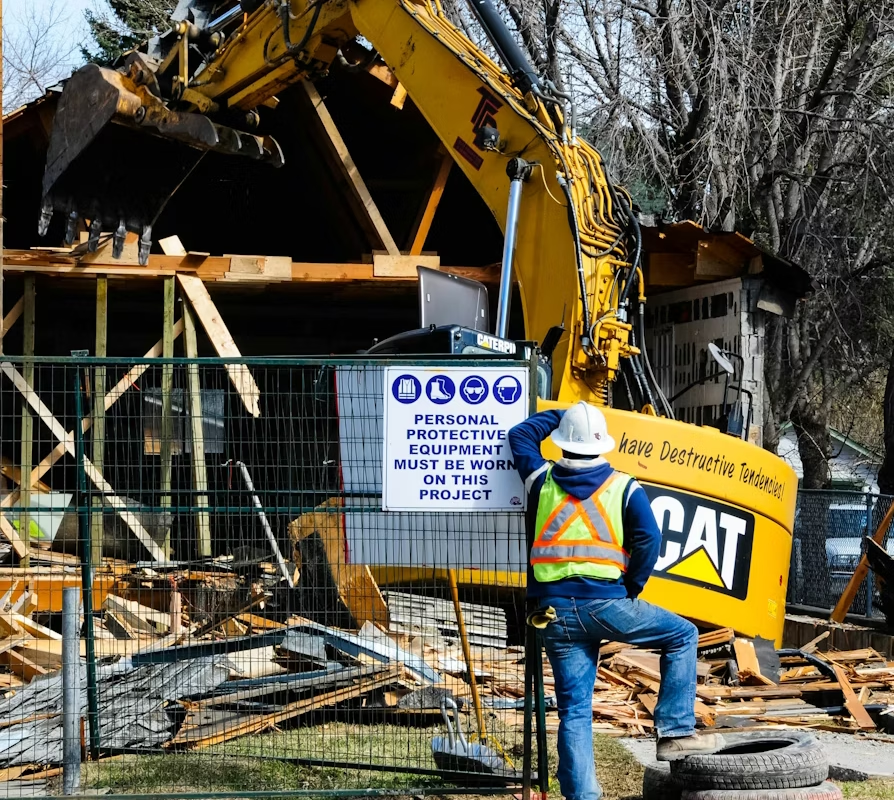
Explore how early cut and fill strategy, sequencing and on‑site material management shape cost, programme and environmental outcomes on development projects.
The 2025 Autumn Budget has delivered a mix of infrastructure commitments, planning system reforms and skills funding, but alongside persistent cost pressures for construction businesses. The overall outcome is mixed: some medium-term pipeline clarity, but little relief for inflationary cost pressures or immediate sector-wide growth.
Key Budget Measures & What They Mean for Construction / Built Environment
BCIS / Sector Assessment — How This Lines Up with Prior Expectations
Using the Red-Amber-Green framework, where Red = no meaningful progress, Amber = some movement but insufficient detail, and Green = a positive or meaningful step forward:
Building Safety Act Implementation
The Autumn Budget did not introduce new measures to accelerate the Building Safety Act regime, but it sits against a backdrop of operational changes within the Building Safety Regulator (BSR) intended to improve the approval process. From January, the Building Safety Regulator will also become independent from the Health and Safety Executive, which is intended to strengthen its capacity and focus as it continues to manage high volumes of Gateway 1–3 applications.
Recent updates show the BSR is making progress on clearing delays in Gateway 2 approvals: the number of older, outstanding cases was almost cut in half over 12 weeks, and more than 500 applications were processed. The regulator has also restructured its process, shifting new-build higher-risk building cases into an “Innovation Unit” to increase throughput, although overall volumes remain high and remediation cases continue to experience delays.
The Budget did not provide additional direct support, funding or legislative measures to accelerate these processes. Instead, implementation challenges around Gateways 1–3 remain, and while BSR operational reforms are helping, approvals are still likely to be a limiting factor for project timelines. The regulator aims to clear its legacy Gateway 2 backlog by the end of January, but the Budget itself did not materially influence this trajectory.
Disputes & Risk Management
Evolving disputes and risk environment for construction and engineering firms:
Housing Market
House prices are rising only marginally and remain below inflation. First-time buyer activity is subdued, and valuation pressures at the upper end of the market (e.g., mansion tax discussions) create market uncertainty. Consultancy capacity remains constrained.
How can we help?
Conclusion
The Autumn Budget offers some constructive elements (infrastructure funding, planning capacity, skills support), but also substantial cost pressures and limited support for private housing demand or immediate sector-wide growth. For firms like ours, the most sustainable path forward lies in sensible risk management and selective tendering.
Explore how early cut and fill strategy, sequencing and on‑site material management shape cost, programme and environmental outcomes on development projects.
Rising geopolitical tension does not affect development viability in isolation, but through increasing pressure on energy prices, supply chains and the cost of energy‑intensive materials. Where schemes are progressed on assumptions made under more stable conditions, these pressures can quickly challenge margins, appraisals and deliverability, particularly in a flat housing market. Our article looks at how developers can respond to build cost volatility in a more informed and proportionate way. Drawing on our specialists' experience, it explores how early coordination, design‑led value engineering and integrated decision‑making can help manage cost risk, protect scheme viability and avoid short‑term measures that compromise long‑term quality and value.
Welcome to our April 2026 newsletter. In this month's Brookbanks newsletter, learn more about how high-rise developments can be made more deliverable, with guidance on how you can reduce risk and protect viability. We're also looking back on our April webinar, where Annabel Le Lohe and Katherine Peers gave a rundown of Environmental Impact Assessments and how coordination can make a real impact on project delivery. Plus, there's a recap of this month's podcasts featuring two special guests. Paul Smith, Managing Director at The Strategic Land Group, and Tom Park, Associate Development Director at Caddick Developments. Also, find out which members of our team will be at UKREiiF as well as more about the CPD event we're co-hosting with the LPDF in May.