Skip to content

Through planning policy requirements, developers are required to engage early on viability issues during the initial planning process. Sites must also demonstrate that they can be brought forward with a suitable level of contribution to the local community, whilst delivering an acceptable level of profit for the developer.

In today’s world of cost inflation and scarcity of suitable land it essential to benchmark and appraise sites as early as possible in the planning and development lifecycle.

Brookbanks is in a unique position of being able to advise landowners, land promoters, and developers at every stage of development on both costs and viability using our innovative tools and our cradle to grave approach. We utilise our in-house specialist teams comprised of experts who can deliver cost effective and reliable advice.

We pride ourselves on ensuring that decisions made during the planning process result in deliverable and cost-effective schemes for our clients. Without this, planning consents risk being gained without the true cost and buildability of a scheme being fully appraised.

Please contact us for more information on what we can do to assist your scheme.

More News

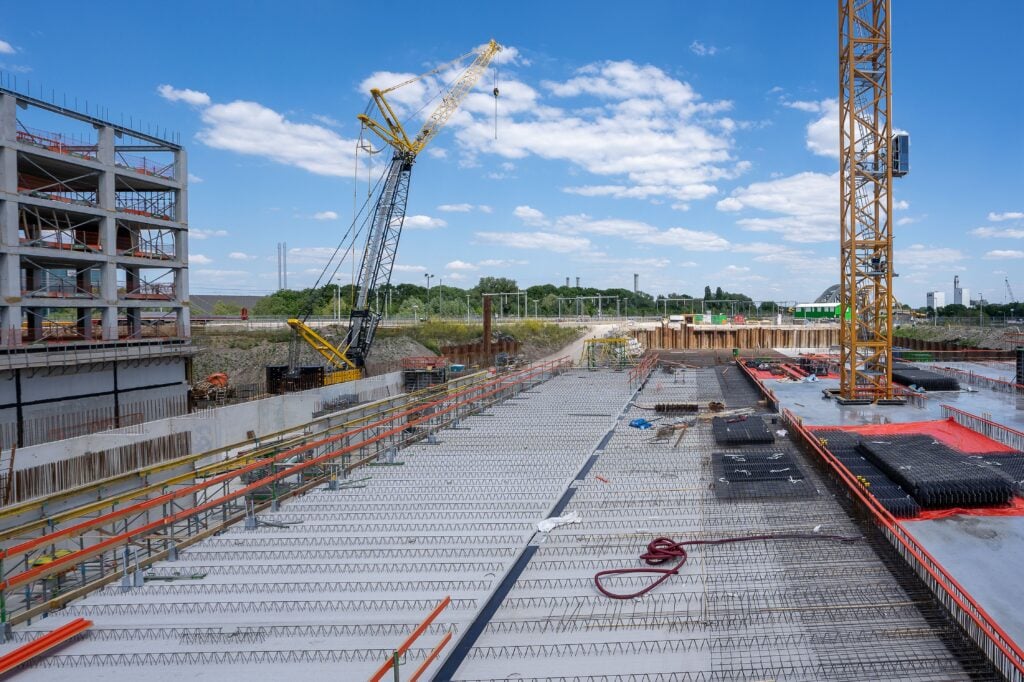
View of a busy construction site with cranes and building structure under clear sky.

Podcast #18: Design of Transfer slabs and efficient structures

June 2, 2026

As development sites become more constrained and expectations around multi-use building designs continue to rise, structural engineering choices are playing an increasingly important role in successful delivery. In our latest podcast, “Design of Transfer slabs and efficient structures,” Ben is joined by Chris Vivian and Devi Varatharajan to explore current industry trends in concrete design. The discussion focuses on how transfer slabs impact construction efficiency, carbon footprints, and why early-stage engagement is critical to optimizing building design.


Read More
Group of students and teacher walking in a school courtyard with modern architecture and playground.

Delivering Education Infrastructure: Direct Delivery or Section 106 Contributions?

May 22, 2026

Education facilities play a vital role in shaping successful residential communities. Alongside providing essential school places for growing populations, they help create well-connected neighbourhoods, support long-term community wellbeing and contribute positively to placemaking outcomes. For developers bringing forward significant housing schemes, deciding how education infrastructure obligations should be delivered is rarely straightforward. In most cases, this involves either directly delivering a new education facility as part of the development, or making a financial contribution through a Section 106 Agreement to support provision elsewhere. Each approach carries implications for cost, programme, planning strategy and the long-term success of the development.

Read More
Aerial view of various vehicles driving on asphalt road near typical residential houses in suburban district on sunny day

Podcast Episode #17: Moving Places, Managing Noise

May 20, 2026

As development sites become more constrained and expectations around placemaking continue to rise, the interaction between transport planning and acoustics is playing an increasingly important role in successful design. In our latest podcast, “Moving Places, Managing Noise,” Ben Wakling is joined by Melanie A’Lee and Tom Quaife-Jones to explore how these two disciplines come together in practice. The discussion focuses on how early coordination between transport and noise specialists can improve scheme viability, reduce planning risk and ultimately create better places to live.

Read More