
Podcast #18: Design of Transfer slabs and efficient structures
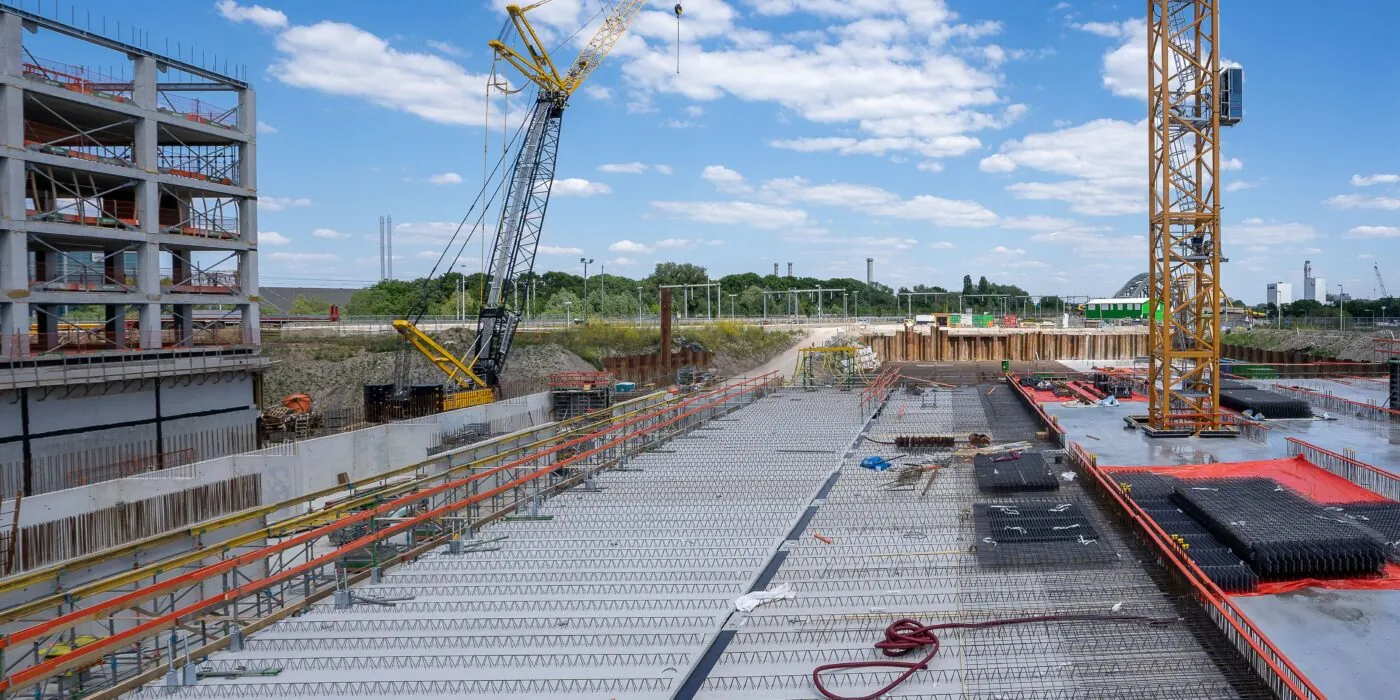
As development sites become more constrained and expectations around multi-use building designs continue to rise, structural engineering choices are playing an increasingly important role in successful delivery. In our latest podcast, “Design of Transfer slabs and efficient structures,” Ben is joined by Chris Vivian and Devi Varatharajan to explore current industry trends in concrete design. The discussion focuses on how transfer slabs impact construction efficiency, carbon footprints, and why early-stage engagement is critical to optimizing building design.
What is a Transfer Slab?
In multi-story construction, layout needs can change dramatically from the upper residential floors to lower commercial or parking levels. This is where a transfer slab becomes necessary.
As Chris Vivian explains in the podcast, a transfer slab is a super-strong floor slab that structurally transfers heavy architectural loads from the columns and walls above to a completely different layout of support columns below. Because they bear the weight of multiple floors, transfer slabs are typically twice the depth of a standard floor slab and require significantly more reinforcement.
Solving Architectural Challenges and Current Industry Trends
By serving as a structural bridge, it allows developers to maximize space layout changes between different levels of a building, such as transitioning from tight residential apartment walls to wide-open commercial ground floors or underground parking grids.
Recently, there has been a noticeable increase in industry and legislative attention surrounding transfer slabs. As building regulations place greater emphasis on structural efficiency, material optimization, and safety compliance, engineers are facing tighter constraints. Designing these massive components improperly can lead to structural issues quickly, prompting a reassessment of how and when they are implemented.

The Role of Carbon Reduction and Construction Challenges
While transfer slabs offer immense architectural freedom, they come with substantial structural and environmental costs.
-
The Carbon Conundrum: Because transfer slabs require double the concrete depth and heavy steel reinforcement, they carry a massive embodied carbon footprint.
-
Construction Complexity: Beyond their environmental footprint, the physical construction of a transfer slab introduces significant onsite logistical challenges. They require extensive formwork, heavy crane lifting capacities, and complex concrete pouring logistics.
-
Cross-Dripline Working: The podcast highlights how technical factors, such as working near tree root protection zones (cross-dripline working), can add further constraints, limiting where heavy foundations and support columns can be placed near the boundaries of a site.
The Value of Early-Stage Engagement
A central theme of the discussion is the critical benefit of engaging structural engineers at the earliest phases of a project’s design.
Early collaboration between architects and engineers allows teams to align column grids across different floors from the outset. This proactive approach can:
-
Design out transfer slabs completely, or significantly minimize their required thickness.
-
Drastically reduce embodied carbon by saving substantial amounts of concrete and steel.
-
Lower construction risk and eliminate expensive, time-consuming onsite processes.
-
Deliver meaningful cost savings across the entire lifecycle of the build.
Ultimately, the conversation reinforces that modern, successful development requires a balance between design ambition and material efficiency. By introducing integrated thinking early on, developers can meet both structural and sustainability goals without sacrificing the commercial viability of their schemes.
Listen to the Podcast
Listen to “Design of Transfer slabs and efficient structures” on our YouTube channel to hear the full discussion with Ben, Chris, and Devi, and gain practical insights into how efficient concrete design supports better development outcomes.

Head of Cost and Commercial
Ben Wakeling
Read Profile
Group Director for Structural Engineering
Chris Vivian
Read ProfileMore News

Brookbanks Podcast #22: Planning, Engineering & Reality
August 4, 2026
Development projects often begin with a clear vision, a well-considered masterplan and ambitious objectives for the future of a site. As schemes progress, planning, infrastructure, engineering and commercial considerations all play a role in shaping how that vision is ultimately delivered. In the latest episode of the Brookbanks Podcast, Lee Witts, Group Director, and Richard Moorcroft, Chief Technical Officer, discuss the relationship between planning aspirations and delivery realities, exploring how projects evolve as they move through the development lifecycle. Drawing on their experience across planning, infrastructure and project delivery, Lee and Richard share their perspectives on why plans can sometimes look different on paper than they do when a scheme reaches delivery, and how greater collaboration between disciplines can help create stronger outcomes for clients and stakeholders.

Brookbanks Podcast Episode #21: Climate Change Adaptation
July 27, 2026
In this episode of the Brookbanks Podcast, Katie Glaze, our Director of Sustainability, is joined by Mark Standen of BRE and Pantelis Levantis of Ecoveritas to discuss climate change adaptation and what it means for the future of the built environment in the UK. The conversation explores how designers, developers and portfolio owners can respond to rising temperatures, changing weather patterns and evolving climate conditions, alongside practical measures that can improve building resilience and long-term performance.