Skip to content
From above electronic calculator and notepad placed over United States dollar bills together with metallic pen for budget planning and calculation

Section 106 (S106) agreements play a vital role in shaping sustainable communities by ensuring that developments contribute to essential infrastructure and services. However, recent research highlights a growing challenge: billions of pounds in developer contributions remain unspent by local authorities. At Brookbanks, we believe understanding the purpose of these agreements, and how to recover unspent funds, is critical for developers and stakeholders alike.

What Are Section 106 Agreements?

Grounded in the Town and Country Planning Act 1990, S106 agreements are legal obligations designed to mitigate the impact of development. They must be:

  • Necessary to make the development acceptable in planning terms
  • Directly related to the development
  • Fairly and reasonably related in scale and kind

Typically, these agreements cover contributions for highways, education, affordable housing, and community facilities. They are binding on the land and can be modified or discharged under certain conditions.


The Scale of Unspent Contributions

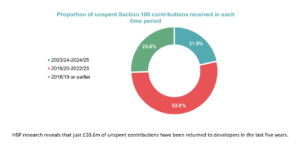
According to recent Home Builders Federation (HBF) research, local authorities in England and Wales are holding over £8 billion of infrastructure payments by developers, including more than £6 billion from S106 agreements and nearly £2 billion from the Community Infrastructure Levy (CIL). Alarmingly, only £20.6 million has been returned to developers in the last five years

.

Macro shot of golden British pound coins showcasing intricate designs and details.

Why Are Funds Sitting Idle?

Several factors contribute to this issue:

  • Limited resources within local authorities to manage and deliver projects
  • Delays caused by procurement or political changes
  • Poor tracking of obligations across departments
  • Narrow or outdated specifications in agreements
  • Risk-averse spending approaches


Why Aren’t Developers Claiming?

For many developers, recovery of unspent contributions is not a priority. Reasons include:

  • Focus on future developments rather than historic agreements
  • Lack of robust documentation and payment records
  • Desire for contributions to be used as intended
  • Concerns about straining relationships with local authorities

The Benefits of Recovery

Actively pursuing unspent contributions offers significant advantages:

  • Improved cash flow and financial flexibility
  • Enhanced margins and reinvestment opportunities
  • Stronger stakeholder confidence and proactive financial management
  • Encourages local authorities to use future contributions effectively


Practical Next Steps for Developers

To maximise recovery opportunities:

  1. Locate and review all signed S106 agreements
  2. Note key dates and repayment deadlines
  3. Create a schedule of contributions made and due
  4. Submit requests to local planning authorities
  5. Engage collaboratively with LPAs
Close-up of an elegant pen resting on an open notebook in a stylish office environment.

How Brookbanks Can Help

We’ve launched a dedicated Section 106 recovery service to support developers in reclaiming unspent contributions. Our team will:

  • Review all agreements and identify funds eligible for repayment
  • Liaise with developers to prioritise recovery
  • Work collaboratively with local authorities to ensure successful outcomes

To learn more watch the full webinar, or contact Ben Wakeling at ben.wakeling@brookbanks.com and connect on LinkedIn.

Ben Wakeling, Head of Cost and Commercial at Brookbanks
Head of Cost and Commercial

Ben Wakeling

Read Profile

More News

Two pale cream coloured dethatched houses, with grey roofs. Built by SME developers in the UK under the guidance of Brookbanks.

The Real Challenges Facing SME Housebuilders

March 3, 2026

The UK’s housing delivery challenge is well-documented. Yet amid the national conversation about planning reform, infrastructure, and build-out rates, one group consistently punches above its weight: Small and Medium-Sized Enterprise (SME) housebuilders. SMEs are a vital part of the solution, but they face very real and persistent hurdles development strategies.

Read More
three electric vehicle chargers attached to a red brick wall in an outside car park

Delivering EV Charging Infrastructure: Helping Developments Meet Today’s Demands and Tomorrow’s Expectations

February 25, 2026

At Brookbanks, we know EV charging becomes far more manageable when it’s approached as part of a wider development picture rather than an isolated task. Rising regulatory demands, limited capacity, cost pressures and the realities of underground or enclosed parking all interact in ways that can affect programme, viability and long‑term performance. This article looks at the recurring challenges we see across residential, commercial and mixed‑use projects and the practical steps that help developments meet Part S requirements, manage grid limitations, integrate load‑balancing and smart‑charging systems, and plan for solar PV and battery storage. The aim is to provide clear, grounded insight that helps teams design EV strategies that genuinely stand up to modern development demands.

Read More