




Skip to content
From above electronic calculator and notepad placed over United States dollar bills together with metallic pen for budget planning and calculation

Section 106 (S106) agreements play a vital role in shaping sustainable communities by ensuring that developments contribute to essential infrastructure and services. However, recent research highlights a growing challenge: billions of pounds in developer contributions remain unspent by local authorities. At Brookbanks, we believe understanding the purpose of these agreements, and how to recover unspent funds, is critical for developers and stakeholders alike.

What Are Section 106 Agreements?

Grounded in the Town and Country Planning Act 1990, S106 agreements are legal obligations designed to mitigate the impact of development. They must be:

  • Necessary to make the development acceptable in planning terms
  • Directly related to the development
  • Fairly and reasonably related in scale and kind

Typically, these agreements cover contributions for highways, education, affordable housing, and community facilities. They are binding on the land and can be modified or discharged under certain conditions.


The Scale of Unspent Contributions

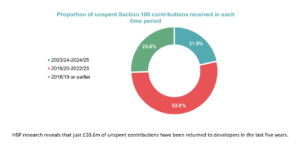
According to recent Home Builders Federation (HBF) research, local authorities in England and Wales are holding over £8 billion of infrastructure payments by developers, including more than £6 billion from S106 agreements and nearly £2 billion from the Community Infrastructure Levy (CIL). Alarmingly, only £20.6 million has been returned to developers in the last five years

.

Macro shot of golden British pound coins showcasing intricate designs and details.

Why Are Funds Sitting Idle?

Several factors contribute to this issue:

  • Limited resources within local authorities to manage and deliver projects
  • Delays caused by procurement or political changes
  • Poor tracking of obligations across departments
  • Narrow or outdated specifications in agreements
  • Risk-averse spending approaches


Why Aren’t Developers Claiming?

For many developers, recovery of unspent contributions is not a priority. Reasons include:

  • Focus on future developments rather than historic agreements
  • Lack of robust documentation and payment records
  • Desire for contributions to be used as intended
  • Concerns about straining relationships with local authorities

The Benefits of Recovery

Actively pursuing unspent contributions offers significant advantages:

  • Improved cash flow and financial flexibility
  • Enhanced margins and reinvestment opportunities
  • Stronger stakeholder confidence and proactive financial management
  • Encourages local authorities to use future contributions effectively


Practical Next Steps for Developers

To maximise recovery opportunities:

  1. Locate and review all signed S106 agreements
  2. Note key dates and repayment deadlines
  3. Create a schedule of contributions made and due
  4. Submit requests to local planning authorities
  5. Engage collaboratively with LPAs
Close-up of an elegant pen resting on an open notebook in a stylish office environment.

How Brookbanks Can Help

We’ve launched a dedicated Section 106 recovery service to support developers in reclaiming unspent contributions. Our team will:

  • Review all agreements and identify funds eligible for repayment
  • Liaise with developers to prioritise recovery
  • Work collaboratively with local authorities to ensure successful outcomes

To learn more watch the full webinar, or contact Ben Wakeling at ben.wakeling@brookbanks.com and connect on LinkedIn.

Ben Wakeling, Head of Cost and Commercial at Brookbanks
Head of Cost and Commercial

Ben Wakeling

Read Profile

More News

construction site, crane, construction machinery, construction work house construction, construction site, construction site, construction site, construction site, crane, crane, crane, crane, crane

Making High Rise Developments Deliverable

April 17, 2026

High‑rise developments rarely fail through lack of ambition, but through risks that are identified too late. When planning, infrastructure, fire strategy, servicing and buildability are treated as separate exercises, schemes often look strong in concept but weaken rapidly at delivery, leading to redesign, delays and value erosion. This article explores why early, joined‑up thinking is essential for tall buildings, and how front‑end due diligence and integrated strategy can reduce risk, protect viability and create schemes that are genuinely deliverable.

Read More
Brookbanks project at pre-build stage with diggers preparing the ground.

Why Foundation Strategy is a key for Infrastructure Delivery

April 3, 2026

Ground conditions remain one of the biggest sources of cost, carbon and programme risk in infrastructure delivery, yet foundation strategy is still too often considered too late. When layouts and levels are fixed before the ground is understood, projects lose the chance to shape efficient, predictable outcomes. This article explores why early, ground‑led design matters and how treating foundation strategy as a front‑end decision can unlock clarity, reduce risk and improve overall project performance.

Read More